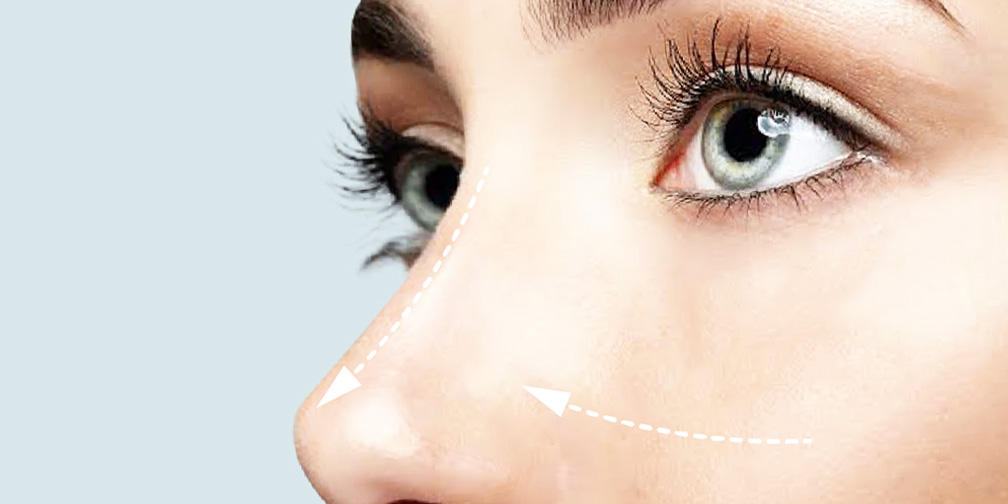
What is Rhinoplasty (Nose Surgery)?
Rhinoplasty is a surgical procedure to reshape the nose. If the nasal septum, the central partition of the nose, is also to be addressed, the procedure is called septorhinoplasty. If the nose is to be reduced, a certain amount of cartilage will be removed, so it is called Reduction Rhinoplasty. If it is to be enlarged and supported, it is called Augmentation Rhinoplasty. This should be determined according to racial and structural support tissues and the individual's characteristic facial features. If the angle relative to the upper lip (nasolabial angle) is to be changed, or if only the shape of the tip of the nose is to be changed, it is called “Tip Plasty.” It is important to treat the nose as a whole and to achieve an attractive appearance while optimizing breathing functionality with surgical techniques. The nasal septal cartilage sometimes shows curvature (deviation) or dislocation (luxation), disrupting the symmetry of the nose and airflow, and may lead to asymmetry or closure of the nostrils. It prevents comfortable, easy, and healthy breathing. The angle and position of the cartilages, as well as their weak and thin structure, cause the cartilages to collapse inward during breathing (alar collapse). One of the reasons for this may be nasal valve insufficiency. Therefore, when evaluating a patient who is a candidate for surgery, these anatomical abnormalities must be carefully identified before surgery, and the entire surgical process must be designed to correct these deformities. As a result, rhinoplasty can be performed for functional or cosmetic reasons. corrective surgery
A curvature in the bony part of the nose may manifest as displacement of the nasal pyramid and nasal axis. A hump nose (dorsal hump) is the presence of a protrusion on the bridge of the nose consisting of bone or cartilage. Cartilage deformities, an overly large nose, and asymmetry in the nose structure are among the reasons that necessitate rhinoplasty. In operations performed for aesthetic purposes, the ideal nose should be designed to suit both the nose and the person's facial features. Nose surgeries are generally widely performed operations.
It is very important that the nostrils are symmetrical and of an appropriate size. Before the operation, photographs are usually taken so that the patient can have an idea of their new appearance. Computer-assisted simulations are performed. The final planned result is shared with the patient, and mutual exchange of ideas takes place to clarify expectations and reach a consensus. These photographs can be effective both in clarifying post-operative expectations and in guiding the surgeon during the operation.
Patients should share the medications they are taking with their doctor. Aspirin and medications with blood-thinning effects can negatively affect clotting functions and increase bleeding. It is important to remember that it is crucial for your doctors to know all the medications and supplements you are taking for your health and recovery. Cosmetic rhinoplasty may not be appropriate in the presence of health problems that can cause excessive bleeding, such as hemophilia.
There are various techniques and technologies used in nose surgery. The choice between open and closed techniques should be determined based on the patient's needs. Significant curvature, loss of support, or deformities in the nasal pyramid and septum are reasons to prefer the open technique. Sometimes, the open rhinoplasty technique is preferred for individuals who have previously undergone a different type of nose surgery. The biggest advantage of the open technique is the wider field of view and the ease of applying appropriate grafts. With the appropriate suture technique, the scar heals completely.
In closed nose surgery, incisions are made inside the nose, and sutures are applied inside the nose at the end of the operation. The surgery generally lasts 1-3 hours. The recovery period after surgery is very short. We prefer general anesthesia for the operation. We require the patient to go to the hospital one day in advance to have blood tests and any necessary additional evaluations and consultations, and we also require an evaluation by the anesthesiologist.
We keep the patient under observation in the hospital for one night after surgery. Necessary medical care and local ice compresses are applied on the first night. Silicone tampons, which also allow the patient to breathe through the nose, are placed inside the nose, and protective splints are applied to the bridge of the nose. The silicone tampons are usually removed on the second day. The protective splint on the bridge of the nose is removed after 1 week, and a skin-colored hypoallergenic plaster is applied to the bridge of the nose for an additional 5-7 days. Four hours after surgery, the patient can drink water, eat, and get up. After being kept under observation for one night, the patient is discharged the next day.
Medications recommended by your doctor should be taken without interruption after nose surgery. Patients can usually return to work within 1 week to 10 days. Mild swelling and bruising after the operation are normal and usually disappear completely within a week.
As a general approach, individuals who have previously undergone rhinoplasty and are dissatisfied with the results should wait at least one year before undergoing a new evaluation. At the end of this period, the final results of the previous surgery are evaluated, and a second corrective surgery may be performed if necessary.